
FAAC Gate Repair in Upland: A Homeowner’s Guide
FAAC gate repair in Upland usually means one of three things: a gate that stops mid-swing, a remote that gets ignored, or a warning light that blinks in a pattern you don’t recognize. Most of the time, the fix is simpler than the failure feels, but only if the technician understands how FAAC’s hydraulic logic actually works. If you’d rather not spend your Saturday decoding blink codes, call (833) 918-6938 and we’ll sort it out.
Here’s the thing about FAAC operators that surprises most Upland homeowners: they fail quietly. No grinding gears, no smoke, no dramatic collapse. Just a gate that loses its rhythm. That subtlety is exactly why so many FAAC systems get misdiagnosed as generic “electrical problems” when the real issue is hydraulic pressure loss or a tired capacitor. FAAC builds hydraulic swing operators, which behave fundamentally differently from the electromechanical motors most gate techs cut their teeth on. Understanding that difference changes everything about how a repair should go.
Why FAAC Hydraulic Systems Confuse Generalist Technicians
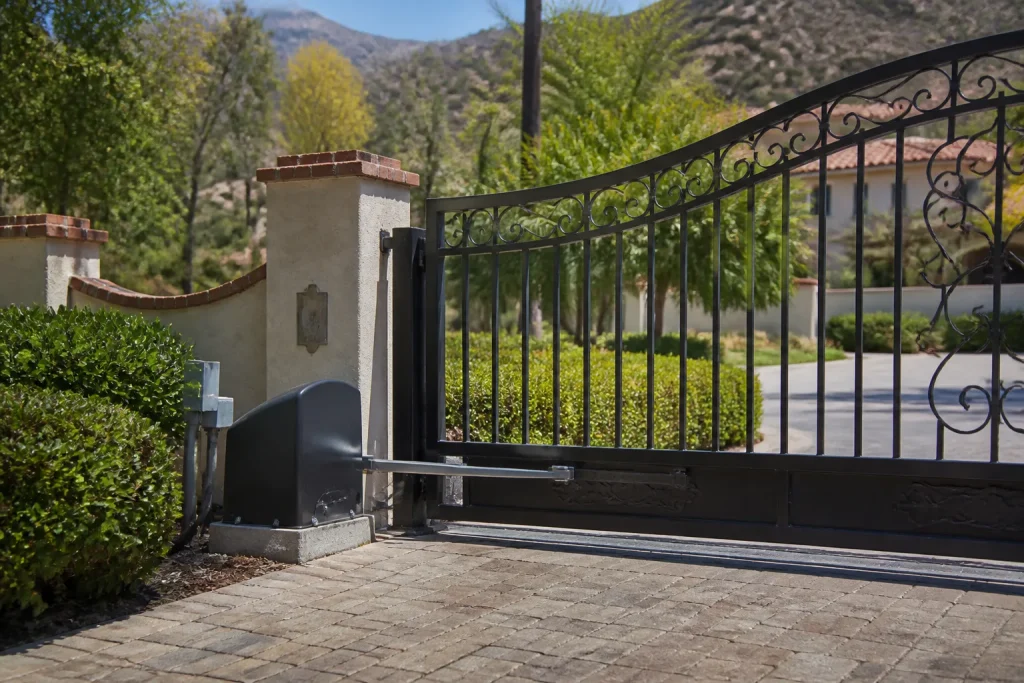
FAAC’s residential swing operators, like the 400 Series and the 750/760 models, use pressurized hydraulic fluid to move the gate arm. An electromechanical operator spins a motor that turns a screw or chain. A hydraulic operator pushes fluid through a cylinder. That’s not a small distinction on a repair call.
When a hydraulic FAAC gate starts creeping open, losing force, or stopping halfway through its arc, the root cause is usually fluid-related, not motor-related. The pump still spins. The control board still sends commands. But the fluid has thickened from years of Upland summer heat, or a seal has begun bypassing pressure internally. A technician who’s never worked on hydraulic systems will replace the control board, charge the homeowner, and leave. The gate still drifts. Then they’re back out replacing limit switches. Then a capacitor. Eventually they stumble onto the fluid issue, but only after the homeowner has paid for three wrong guesses.
That’s the difference between gate repair in Upland done by a gate-only shop and a repair attempted by someone who mostly does garage doors or fences. FAAC diagnostic thinking follows brand logic: check the pump, check the bypass pressure, check the fluid, then check the board. In that order.
What Actually Fails on FAAC Operators in Upland’s Climate
Southern California weather is hard on gate equipment in specific, predictable ways. We see the same handful of failure modes across Upland, from the older neighborhoods north of Foothill Boulevard down to the newer developments near the 210. Here’s what’s actually going wrong most of the time:
- Hydraulic fluid degradation. Upland’s inland heat cycles bake the fluid inside FAAC operators. After enough 100-degree summers, the fluid loses viscosity and breaks down. The gate starts moving slower in the morning, then slower overall, then it stalls mid-cycle. The fix is a fluid flush and replacement, not a new motor.
- Capacitor failure. FAAC operators rely on start capacitors to give the pump enough torque to begin each cycle. Capacitors degrade with heat exposure. When one fails, the gate may hum but not move, or open fine but struggle to close. A $30 part, but only if you know to test it first.
- Encoder drift. On newer FAAC models with magnetic or optical encoders, years of thermal expansion and contraction can cause the encoder to lose its position reference. The gate may think it’s fully closed when it’s still six inches open, or it may reverse at the wrong point. Recalibration fixes it, but only if the technician knows the FAAC programming sequence.
- Seal bypass in the hydraulic cylinder. Internal seals wear over time, allowing fluid to slip past the piston. The gate loses holding force and can be pushed open by hand. This reads like a mechanical problem but presents as “the gate won’t stay closed,” so it gets mislabeled as an electronic fault.
None of these failures require a full operator replacement. But all of them require a technician who recognizes FAAC-specific symptoms at a glance rather than working through a generic troubleshooting checklist.
Reading FAAC Error Codes: The 740D and 844 Boards
If your FAAC operator has a 740D or 844 control board, the blinking LED isn’t decoration. It’s a diagnostic readout. FAAC uses a sequence-based fault indication system, and the pattern of blinks tells you what the board thinks is wrong. Here’s what the most common patterns indicate:
- One blink, pause, repeat: The board detects a fault on the motor or pump circuit. On hydraulic units, this often means the pump capacitor is weak or the motor winding is drawing too much current. It’s rarely the board itself.
- Two blinks: Limit switch fault. The board can’t confirm the gate position. Could be a failed limit switch, a wiring break at the hinge, or encoder desynchronization on newer models.
- Three blinks: Safety device triggered. If your photoelectric eyes or safety edge are misaligned, dirty, or damaged in Upland’s dust and sun, the board refuses to operate. Cleaning and realigning usually clears this without any part replacement.
- Four blinks: Overcurrent or thermal protection engaged. The operator has been working too hard, often due to worn hinges, low hydraulic fluid, or a gate that’s binding. Fix the mechanical issue first, then reset the board.
- Rapid continuous blinking: The board is in programming mode or has detected a memory error. Don’t start pressing buttons to “help.” Call someone who knows the FAAC programming menu.
One honest note: we’ve pulled electric gate repair in Upland jobs where the homeowner had already replaced a perfectly good control board because a YouTube video told them the blinking light meant the board was fried. It was a dirty safety eye. The blink codes are clues, not verdicts. Learning to read them keeps you from spending real money on the wrong fix.
Why FAAC Parts Must Be FAAC Parts (and Not Amazon “Compatible” Stand-Ins)
Here’s where FAAC ownership gets more specific than most other brands we work on. FAAC designs its hydraulic operators as integrated systems. The pump, the cylinder, the pressure relief valve, and the control board are all calibrated to work together within specific tolerance ranges. Substitute a generic capacitor with the “right” microfarad rating and the pump may start, but it may also draw slightly different current than the board expects. That difference shows up as false fault codes, overheating, or a gate that runs fine for four months and then starts stopping at random.
Generic hydraulic fluid is another common shortcut that causes problems. FAAC specifies particular fluid types for their operators. Pour in whatever’s on the shelf at the auto parts store and you’ll get foam, pressure loss, and eventually seal damage. The repair cost doubles because now the cheap fluid has to be flushed out, the seals replaced, and the correct fluid reinstalled.
We keep FAAC-specific components on the truck for a reason. When an Upland customer calls with a failing 750 or an 844 board throwing codes, we’re not ordering parts and coming back next week. The repair happens on the first visit because the right parts are there. That’s what brand-specific repair means in practice: not just knowing the name “FAAC,” but carrying the parts that keep an FAAC behaving like an FAAC.
How to Verify a Technician Actually Knows FAAC
Every gate company in Upland will tell you they repair all brands. Most will. The question is whether they can diagnose your FAAC by its behavior, or whether they’re going to learn on your gate at your hourly rate. Here’s a short test we recommend homeowners run before scheduling:
- Ask which FAAC models they’ve serviced recently. If they stumble or say “all of them” without naming a series, that tells you something. A tech who knows FAAC will say “the 400 series, the 750, the C720” without pausing.
- Ask whether your operator is hydraulic or electromechanical. If they can’t answer, or try to dodge with “it doesn’t matter,” end the call. It absolutely matters. An electromechanical diagnosis will miss hydraulic-specific failures every time.
- Ask how they diagnose a gate that stops mid-swing. The correct answer mentions checking hydraulic bypass pressure, fluid condition, and capacitor health before throwing a board at it. If the first answer is “we usually replace the board,” keep looking.
- Ask about FAAC error code interpretation. Anyone who’s actually worked on FAAC control boards will know they use blink sequences. If they talk about “reading the manual,” that’s honest but slow. We respect anyone who learns from the manual. But you’re paying for speed.
We work on FAAC, LiftMaster, Elite, and Mighty Mule systems regularly. FAAC is the one that most rewards specialists and most punishes generalists. The hydraulics, the encoder recalibration, the specific fluid specs, the blink-code logic: it’s all learnable, but it isn’t free to learn. You want a tech who already paid that tuition.
The Bottom Line
FAAC operators are among the most reliable gate systems you can own in Upland. That reliability is part of the problem: they go years without needing anything, so when one finally acts up, most generalist technicians have no practical experience with them. The failure is usually hydraulic fluid degradation, a capacitor, or an encoder that lost its position, not the catastrophic board failure everyone jumps to. Reading the blink codes helps you avoid paying for wrong guesses. Insisting on FAAC-specific parts keeps the system behaving correctly after the repair. And verification questions separate real brand expertise from confident guessing.
If you’re in Upland and your FAAC gate is acting up, we offer free estimates and same-day service on most repair calls. Call (833) 918-6938 and tell us what the gate is doing. The blink code, the noise, the behavior: give us the symptoms and we’ll know where to start. If a full replacement makes more sense than another repair, we handle gate installation in Upland too, so you won’t need a second company either way.
One story before the FAQs, because it captures the whole point: we got called out to a home near San Antonio Heights last fall. The FAAC 750 had been losing holding force for weeks, and the homeowner had already paid another company to replace a limit switch. Funny thing, a limit switch wasn’t on the invoice from us because that wasn’t the problem. The hydraulic fluid had never been changed in nine years of Upland heat. A flush, new FAAC-spec fluid, a recalibration. Gate’s run like new since. It wasn’t a hard repair. It was just a repair that required knowing what a 750 acts like when its fluid gives up. That’s the difference.
Frequently Asked Questions
Most FAAC repairs in Upland fall between $180 and $450 depending on the failure. Capacitor replacement and recalibration sit at the lower end. Hydraulic fluid flush with new seals runs higher. Control board replacement, when actually necessary, can exceed $600 including the part. The price is always quoted and agreed before any work starts, so you won’t get a surprise invoice. Call (833) 918-6938 for a free estimate based on the symptoms you’re seeing.
In most cases, yes. We stock FAAC-specific capacitors, fluid, seals, and common board components, so the repair happens on the first visit rather than after a parts order. If your gate is stuck open and your property is unsecured, we prioritize it. Call (833) 918-6938 and describe the failure. We’ll tell you honestly whether it’s same-day or next-morning.
First, check the breaker and any GFCI outlet on the circuit. Upland’s high winds and summer brownouts trip both regularly. Then look at the control board LED. If it’s blinking in a pattern, that’s a fault code telling you what the board sees. If the board is dark and the breaker is good, the transformer or main fuse may have failed. Don’t open the panel and start testing wires yourself, the capacitor inside stores enough charge to hurt. Call a gate technician who reads FAAC blink codes to handle it safely.
FAAC operators routinely last 15 to 20 years with proper fluid maintenance, so repair is usually the better value if the unit is under 12 to 15 years old and the failure is a capacitor, seal, or fluid issue. If the hydraulic cylinder is scored internally, the motor windings have burnt, and the board is throwing memory errors all at once, replacement starts to make more sense. A straight answer comes from a diagnosis, not a sales pitch. We repair and install, so the recommendation you get isn’t weighted toward whichever makes us more money. Call (833) 918-6938 for an honest assessment.
Written by the team at Falcon Gate Repair, serving Upland since 2018. We handle repair and installation for FAAC, LiftMaster, Elite, Mighty Mule, BFT, Linear, Viking, Ghost Controls, and DoorKing gate systems. Visit the Falcon Gate Repair home for our full service area and current availability.
Need Gate Repair Help?
Call Falcon Gate Repair - licensed & insured, here with fast help in Upland.
(833) 918-6938