
Last updated November 2, 2026
 Wrought iron
 Wood & steel frame
 Farm & ranch
 Sliding driveway gates
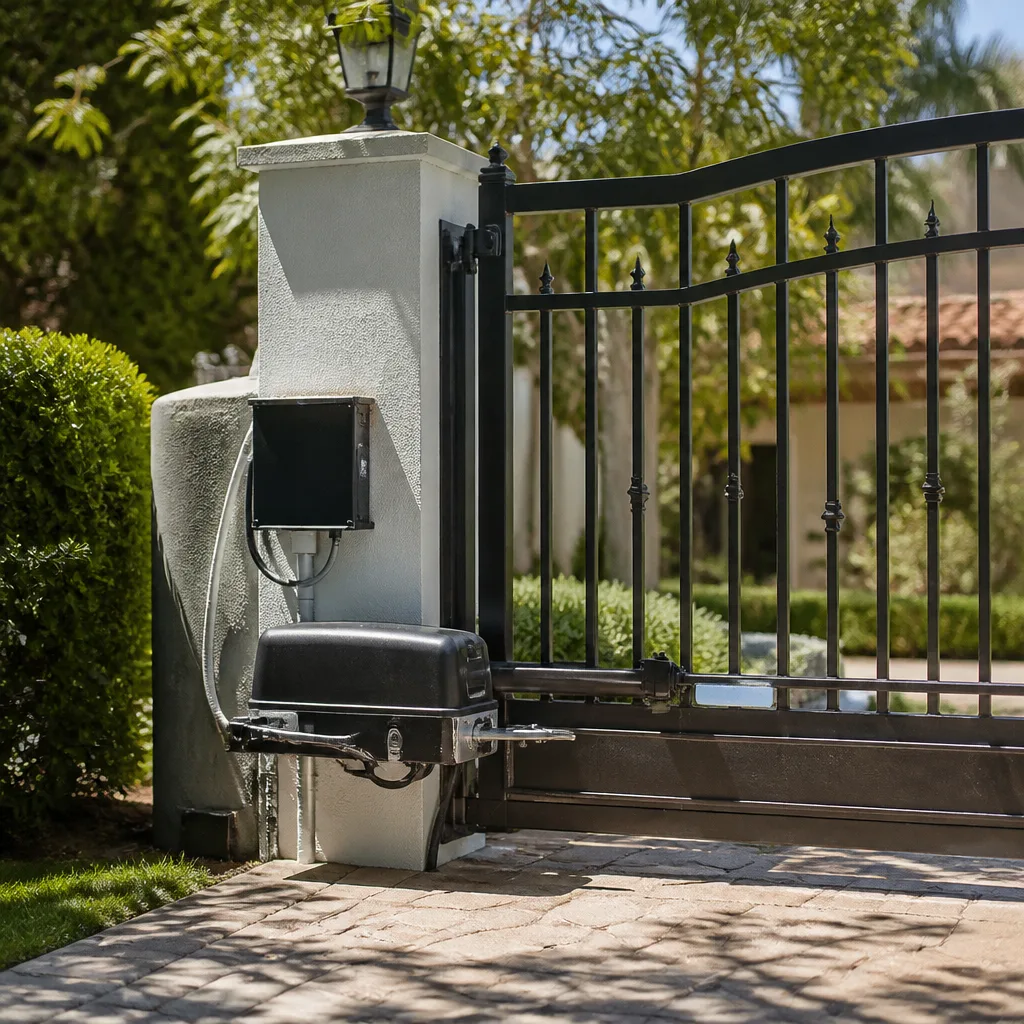 LiftMaster operators
Free on-site gate assessment - hinges, posts, and your LiftMaster or Nice gate operator checked before anything is quoted
The assessment is free and the quote is the invoice.
Get your free estimateGate Repair Permits, Codes & Inspections in CA: What You Need to Know
Here’s a fact most California homeowners learn the hard way: the automatic gate at the end of your driveway is regulated by a federal safety standard that most people have never heard of. UL 325 isn’t a suggestion, a guideline, or a best practice. It is a mandatory entrapment-protection standard that has been woven into California’s building code, and a gate that was installed or modified without meeting it is a liability sitting on your property line. In Upland, where a significant share of homes in neighborhoods like San Antonio Heights and the Colonies have automated driveway gates, this matters more than most people realize. This guide explains what the codes actually say, when you need a permit, and what an inspector is going to look for when they stand in front of your gate.
Styles & brands we work with
- Wrought iron
- Wood & steel frame
- Farm & ranch
- Sliding driveway gates
- LiftMaster operators
Quick Answer
In California, most gate repairs do not require a permit, but most gate operator installations or replacements do, and every automated gate, new or repaired, must comply with UL 325 entrapment protection standards regardless of whether a permit was pulled. In Upland, the threshold is typically operator replacement or structural modification, not swapping a hinge, wheel, or circuit board. Failing to meet UL 325 creates a liability that follows the property, not just the contractor, and can surface during resale inspections or insurance claims.
Table of Contents
- What UL 325 Actually Requires in California
- When a Gate Repair Triggers a Permit in CA
- How to Pull a Gate Permit in Upland
- Entrapment Zone Requirements for Swing Gates
- Insurance Claims and Property Resale: What Happens When an Unpermitted Gate Is Discovered
- Residential vs. Commercial Gate Code Differences
- What a Gate Inspection Actually Checks
- Common Mistakes to Avoid
- When to Call a Professional
- Frequently Asked Questions
- The Bottom Line
What UL 325 Actually Requires in California
UL 325 is a safety standard published by Underwriters Laboratories that governs the design, manufacture, and installation of automated gate operators and other powered door systems. California adopted it into the state building code through Title 24, which means it is enforced by local building departments, including the City of Upland. The standard exists to prevent entrapment – the term for a person, child, or pet being caught, crushed, or dragged by a moving gate.
The core requirements of UL 325 are specific, not vague. Every automated gate must have two independent entrapment protection devices, and both must be monitored or tested on every cycle. A monitored device is one that checks itself for proper function before the gate is allowed to operate. Common combinations include a reversing edge or pressure sensor on the leading edge of the gate plus a photoelectric eye or safety loop in the entrapment zone. You cannot satisfy the standard with one device alone.
For swing gates specifically, UL 325 identifies four distinct entrapment zones: the hinge area, the latch area, the leading edge, and the area between the gate and the opening post. Each zone has specific clearance requirements. A gate that meets clearance in the hinge zone but violates it at the latch post is still out of compliance. We see this regularly in Upland, where older homes built before the current code cycle have gates that were installed with gaps that were never inspected.
Another frequently overlooked requirement is the “gate weight and speed” relationship. UL 325 specifies maximum closing force thresholds and requires that operators be force-limited. In other words, the motor must reverse or stop before applying enough force to injure someone. Brand-specific operators handle this differently. A LiftMaster residential swing operator uses a different force-sensing profile than a DoorKing commercial slide operator, and both are tested to different UL 325 categories.
For residential and commercial property owners in Upland, the practical takeaway is this: UL 325 compliance is not optional, and it cannot be verified by visual inspection alone. The operator’s setting, the sensing edge’s wiring, the photoelectric eye’s alignment, and the physical mounting all have to be tested. That is why the standard is enforced through installation permits and final inspections, not just manufacturer documentation.
If you are curious about what a compliant modern gate operator setup looks like, our Electric Gate Repair in Upland page walks through how sensor and force-limiting systems are serviced on real installations.
When a Gate Repair Triggers a Permit in CA
The threshold question is simple: are you repairing a component, or are you changing the system? California building code treats these differently, and so does the City of Upland. A permit is generally not required for what the code calls “minor repair work” – replacing a hinge, swapping a wheel, rewiring a keypad, or exchanging a control board that has failed. These are component-level fixes that restore the gate to its prior operating condition.
A permit is generally required when one of the following occurs:
- Replacing the gate operator or motor – this is the single most common trigger. Even if you install the exact same brand and model, the new operator must be installed to current UL 325 standards, which may differ from the standard in place when the original was installed.
- Structural modification – lengthening the gate, adding weight to the gate leaf, changing the hinge configuration, or converting a single-leaf to a double-leaf layout changes the load on the operator and the geometry of the entrapment zones. The city treats that as new work.
- New installation or relocation – any gate that did not previously exist, or a gate that is being moved to a different position on the property, requires a permit.
- Adding or changing safety devices in a way that alters the operator’s control circuit – for example, adding a vehicle loop detector or a free-exit system that was not part of the original approved installation.
What confuses many homeowners in Upland is that a contractor may replace a motor and call it a “repair.” Semantically, it may feel like a repair. Under code, replacing the operator is an installation that requires a permit and an inspection. A component swap – same operator, new gear – is a repair.
Here is the simple test we give our Upland customers: if the gate’s operating system, geometry, or safety circuit has changed, assume you need a permit. If you replaced a part to make the existing system work again, you probably do not. When in doubt, call the City of Upland Building Division or a Gate Installation in Upland contractor who files these permits regularly.
How to Pull a Gate Permit in Upland
If you do need a permit, the process in Upland is more straightforward than most people expect, but it rewards preparation. Here is the step-by-step sequence, based on what we’ve navigated with customers across Upland, from the Colonies to north Upland.
- Confirm the permit requirement. Call or visit the City of Upland Building Division and describe the work. Give them the gate type (swing, slide, vertical pivot), the operator brand and model if replacing, and whether any structural work is planned. They will confirm whether a permit is required.
- Gather the documentation. For operator replacement, plan to submit the operator’s UL 325 compliance documentation, which the manufacturer provides with the unit. For structural work, you will need a basic site plan or drawing showing the gate location, clearances, and property line dimensions.
- Submit the application and pay the fee. Upland’s building permit fees are based on project valuation. For a gate operator replacement, plan for a valuation that includes the operator cost plus installation labor. The city will assign a permit number and an inspector will be assigned to your project.
- Complete the work to the approved standard. The installation must meet UL 325 entrapment protections and any local amendments. Do not cover up any part of the installation before the inspection – the inspector needs to see wiring, the operator mounting, and the safety devices.
- Schedule the inspection. After the work is complete, call the City of Upland to schedule a final inspection. The inspector will verify entrapment zones, test the operator’s reversing function, check that the photoelectric eyes are properly aligned, and confirm the system stops and reverses under load.
- Keep the final approved record. Once the inspection passes, retain the approved permit documentation. You will need it when you sell the property, and it is your best defense if an insurance claim is ever filed.
At a practical level, this process usually takes anywhere from a few days to a few weeks depending on the city’s workload and how complete your submittal is. Missing the UL 325 documentation is the most common reason for a delay, so have it in hand before you start.
Entrapment Zone Requirements for Swing Gates
Swing gates have specific, measurable clearance requirements under UL 325, and they are the single area where we see the most violations on existing Upland homes. The gate swings through an arc, and anywhere along that arc where a hand, foot, head, or body could be caught is an entrapment zone that must be addressed.
The four entrapment zones are:
- Hinge zone – the area between the gate leaf and the gate post at the hinge side. The gap must be large enough that fingers cannot be pinched as the gate opens, or protected with a guard that prevents access.
- Latch zone – the area between the gate leaf and the latch post at the opening side. As the gate closes, this gap narrows. If it is narrower than 4 inches at any point, a guard or barrier is required.
- Leading edge zone – the vertical edge of the gate that sweeps through space as it opens or closes. This edge must have a reversing edge or sensing device that stops and reverses the gate if it contacts an obstruction.
- Opening post zone – the space between the moving gate and fixed posts, fences, walls, or other stationary objects. The clearance must prevent a body from being trapped between the gate and the fixed object.
Measuring these zones is straightforward if you know what you are looking for. Close the gate and measure the gaps at the hinge and latch posts. Open the gate fully and measure the clearance between the leaf and any stationary object it passes near. A simple tape measure will identify the most obvious violations. The less obvious violations – force limit settings, edge sensor response time, photoelectric eye span – require testing equipment and a trained eye.
In Upland, older gates installed before current code cycles are the most common source of entrapment-zone violations. A gate that was acceptable 20 years ago may have a latch-post gap that is now non-compliant, or an operator that was never equipped with a monitored reversing edge. If you have a swing gate that predates your ownership of the home, it is worth a specific compliance check.
Insurance Claims and Property Resale: What Happens When an Unpermitted Gate Is Discovered
Here is the part most homeowners never think about until it happens. If an automated gate causes an injury, and a subsequent investigation finds that the gate was not UL 325 compliant, the liability does not stay with the contractor who installed it. It travels with the property.
Homeowner’s insurance policies typically cover personal liability for accidents on the property, but they also typically exclude or limit coverage for damages caused by negligence. A non-compliant gate is treated as a hazardous condition that the property owner was responsible for maintaining, and insurance adjusters look specifically for permit records and inspection documentation when a gate-related injury claim is filed. If the work was done without a permit and the gate was never inspected, proving that you exercised reasonable care becomes significantly harder.
Property resale creates a second exposure point. During escrow, a buyer’s home inspection will often include a check of permitted work against county records. If the gate was added or modified without a permit, the title report or inspection may flag it. In some cases, the seller is asked to retroactively permit the work, which means bringing the gate into current UL 325 compliance before the sale can close. In others, the buyer demands a price reduction to cover the cost of bringing the gate up to code after the purchase.
What makes this particularly relevant in Upland is the prevalence of automated gates as a security feature on upper-market properties in the San Antonio Heights area and the larger custom-home lots north of the 210. A driveway gate is often a prominent part of a buyer’s perception of security, and an unpermitted or non-compliant gate becomes a negotiating point at the worst possible time – when you are already trying to close.
Our general guidance is this: before you list a home in Upland with an automated gate, have the gate system inspected for UL 325 compliance and confirm whether the installation was permitted. If it was not, the cost of correcting it now is almost always lower than the discount a buyer will extract in escrow. The same logic applies to insurance: a documented, inspected, compliant gate is a defense. An undocumented one is a vulnerability.
If you are in Upland and need a gate system inspected or brought up to code, our Gate Repair in Upland page covers the compliance repair work we handle most often.
Residential vs. Commercial Gate Code Differences
California code and UL 325 distinguish between residential and commercial gate systems in ways that affect both design and ongoing maintenance requirements. A residential gate is defined as a gate serving one to four single-family dwelling units. Anything else – a gate serving a multi-family complex, a commercial property, a parking structure, or an industrial facility – falls under commercial classification and a stricter set of performance requirements.
The practical differences are meaningful. Commercial gate systems must use “monitored” entrapment protection devices, which means the device must be tested by the control board on every single gate cycle. If the test fails, the gate operator must disable itself or fail-safe. Residential systems are allowed some flexibility for non-monitored devices in specific configurations, though monitored devices remain the norm for newer Elite and DoorKing installations.
Commercial operators also face different force and speed limits. A commercial slide gate, for example, is governed by different closing force thresholds than a residential slide gate, and the operator must be programmed accordingly. In practice, installers use “commercial” and “residential” board profiles on the operator’s control board, and selecting the wrong profile creates an immediate non-compliance.
For Upland property managers responsible for gated apartment or condominium entrances, the compliance burden is higher, and the City of Upland follows the same state code baseline for commercial work. Annular inspections, logged testing, and records of entrapment-device maintenance are all common expectations from both building inspectors and liability insurers.
One brand note that matters here: DoorKing has long been a workhorse in commercial slide gate applications, and their control boards have a UL 325 compliance profile built in. Mighty Mule, by contrast, is common on residential farm and ranch gates, and is rarely seen on commercial sites in Upland. The brand itself is not the compliance question; the board’s programming and the physical installation are.
We’ve worked on enough of both to say this: the biggest difference between a compliant and non-compliant commercial gate is rarely the hardware. It is whether the operator was configured to the correct UL 325 profile and whether the safety devices were actually tested – not just installed – during the initial setup.
What a Gate Inspection Actually Checks
If you have never been through a building inspection on a gate, here is exactly what the inspector does when they arrive at an Upland property. This is the list, in the approximate order the inspection proceeds:
- Permit documentation review. The inspector verifies the permit number matches the address, and that the approved plans (if any structural work was permitted) match what is physically present.
- Operator identification. The inspector identifies the gate operator brand and model and confirms the UL 325 classification (Class I, II, III, or IV) matches the application. A residential operator on a commercial gate fails.
- Entrapment zone verification. For swing gates, the inspector measures or visually verifies gaps at the hinge and latch posts and checks the guard placement. For slide gates, the inspector checks the distance between the moving gate and fixed objects along the entire travel path.
- Reversing / sensing device test. The inspector triggers the gate and tests the reversing edge or photoelectric eye by introducing an obstruction. The gate must stop and reverse before applying enough force to hold the obstruction.
- Force limit confirmation. The inspector verifies that the operator’s force setting does not exceed the UL 325 threshold. For many modern operators, this is read directly from the control board.
- Wiring and grounding check. The inspector looks at the electrical connections, conduit, and grounding. Exposed or improperly grounded wiring is a code violation independent of UL 325.
- Manual release verification. Every automated gate must allow manual operation in the event of a power failure. The inspector verifies that the manual release mechanism works and is accessible.
- Warning signage. For some installations, particularly commercial, signage identifying the gate as an automatic system with entrapment protection must be posted.
Most failed inspections we see in Upland are not failed because the operator is the wrong brand. They are failed because the entrapment device was wired but not tested, because the force limit was left at the factory default (which is often too high), or because a swing gate’s latch-post gap was never measured. These are all correctable, often in a single service call, but they are also all avoidable when the installer knows what the inspector is going to check.
If you want a more detailed walkthrough of how the electrical side of these systems is serviced and tested, see our Electric Gate Repair in Upland page.
Common Mistakes to Avoid
- Assuming a “repair” is never a permit job. Replacing a hinge is a repair. Replacing an operator is an installation. The distinction matters to the City of Upland and to your insurance coverage, and blurring it is the most common compliance failure we see.
- Buying a cheap operator online and self-installing. A $400 Mighty Mule or big-box operator may be UL 325 listed, but its compliance depends on correct installation – entrapment zones, force settings, and sensing devices configured properly. Most self-installed operators fail those elements.
- Ignoring the latch-post gap on an existing swing gate. This is the most common missed violation in older Upland homes. The gate works fine, but the gap between the gate and the latch post is a finger-pinch zone under current code.
- Not keeping the permit record. The permit is evidence. Without it, you cannot prove the gate was inspected and approved, and that proof is exactly what an insurance adjuster or escrow officer will ask for.
- Replacing a residential operator with a “similar” commercial unit. Class II and Class III operators are not interchangeable with Class I residential units. The wrong class installation fails inspection and, more importantly, may not provide the entrapment protection required for the application.
- Covering the installation before inspection. Burying conduit, closing walls, or landscaping over the operator and sensor wiring before the inspector sees it forces a delay and often a re-exposure of the work at your expense.
- Using a generalist contractor for a gate-specific compliance job. A fence contractor or a general handyman may install a gate that opens and closes, but UL 325 compliance lives in the details – monitored devices, force profiles, control board configuration – that a gate-only specialist troubleshoots daily.
When to Call a Professional
Call a gate-specific contractor when you are replacing an operator, when you are installing a new automated gate, when an inspector has flagged your existing gate for a compliance violation, or when you are preparing to sell a home with an automated gate and want documentation that the system is code-compliant. These are not situations where a generalist’s experience transfers; UL 325 compliance for a swing or slide gate requires specific brand knowledge and code fluency that comes from working with these systems daily, not occasionally.
You should also have a professional inspect any automated gate that was on the property when you bought it and has never been evaluated. Most Upland homeowners have no record of their gate’s installation, and Upland’s housing stock includes many homes with gates installed before current entrapment standards were enforced. Falcon Gate Repair offers free estimates in Upland – call (833) 918-6938 to schedule a compliance review or to get a quote for repair work.
Frequently Asked Questions
Yes, replacing a gate operator generally requires a permit in Upland because the new operator must be installed to current UL 325 entrapment protection standards, which may be stricter than the standard in place when your original operator was installed. Component-level repairs like hinge or circuit board swaps do not require a permit. Call (833) 918-6938 if you are not sure which category your job falls into.
UL 325 is the federal safety standard for automated gate operators that California has adopted into Title 24, making it enforceable by local building departments. It requires two independent entrapment protection devices on every automated gate and sets specific clearance and force limits to prevent injury. A gate that does not meet UL 325 creates liability that follows the property. Call (833) 918-6938 for a compliance review.
Gate permit fees in Upland are based on the valuation of the work, which for a typical operator replacement includes the cost of the operator plus installation labor, so the fee varies by project. The City of Upland Building Division can provide a fee schedule for your specific job. The permit cost is almost always lower than the cost of retroactive permitting or an escrow credit if an unpermitted gate is discovered later.
An unpermitted automated gate can surface during a home sale as a flagged item that the seller must either retroactively permit and bring into compliance or compensate the buyer for at closing. It can also complicate an insurance claim if a gate-related injury occurs, because the absence of inspection records makes it harder to demonstrate that the property owner exercised reasonable care. Falcon Gate Repair can assess your gate and walk you through the Gate Installation in Upland compliance process – call (833) 918-6938.
Most operator brands sold in the U.S. today, including LiftMaster, DoorKing, Elite, and Mighty Mule, are UL 325 listed, meaning the hardware itself is certified. Compliance depends on installation: the operator must be configured to the correct residential or commercial class, the force settings must be within limits, and the entrapment protection devices must be wired, monitored, and tested. The listing is the starting point, not the finish line.
California law allows a homeowner to perform work on their own property, including gate operator installation, but the work still requires a permit in most cases and must still meet UL 325 standards. The practical problem is that entrapment zone measurements, force-limit configuration, and monitored-device testing are not intuitive, and self-installed operators are among the most common sources of non-compliance we see in Upland. If you decide to proceed yourself, have a professional inspect the finished installation before relying on it.
The Bottom Line
California’s gate codes are not a bureaucratic annoyance. They exist to prevent a specific, documented kind of injury, and they are enforced through permits and inspections in Upland. The line between a repair and an installation is the line between no permit and a permit, and it usually falls wherever the operator, the gate geometry, or the safety circuit changes. UL 325 compliance is the non-negotiable minimum for any automated gate, and it is not something a homeowner can verify by watching the gate open and close. Documentation, inspection records, and brand-specific configuration are what protect you when something goes wrong. If you own an automated gate in Upland and you cannot say with confidence when it was last evaluated for compliance, that evaluation is the next phone call you should make.
Call Falcon Gate Repair at (833) 918-6938 for a free estimate on gate repair, compliance work, or new installation. We’re a gate-only specialist, from the motor to the control board, repair or replace – we handle both. Our team works on LiftMaster, DoorKing, Elite, and Mighty Mule systems regularly, and we know what the Upland inspectors are looking for before the inspection happens. Start with our Falcon Gate Repair home page or call us directly.
Written by the team at Falcon Gate Repair, serving Upland since 2018.
See the difference
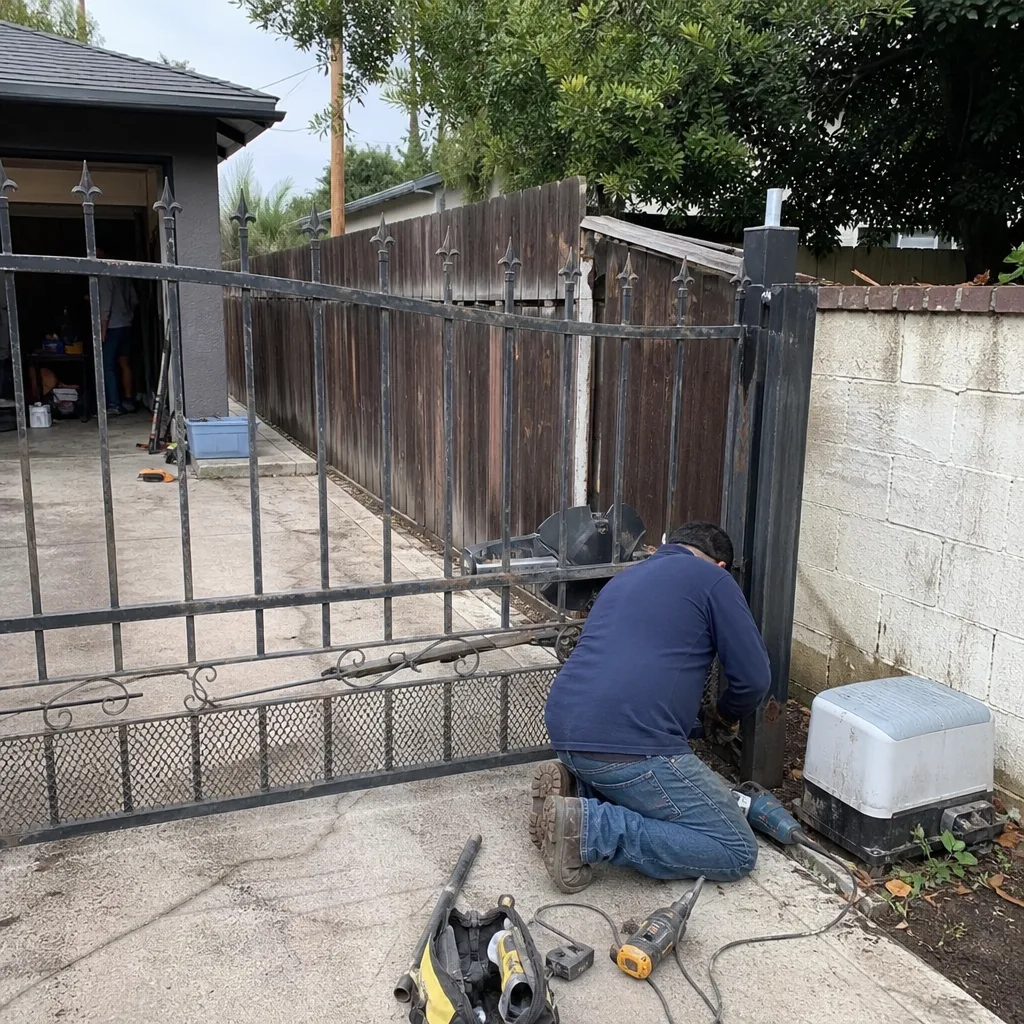 Before
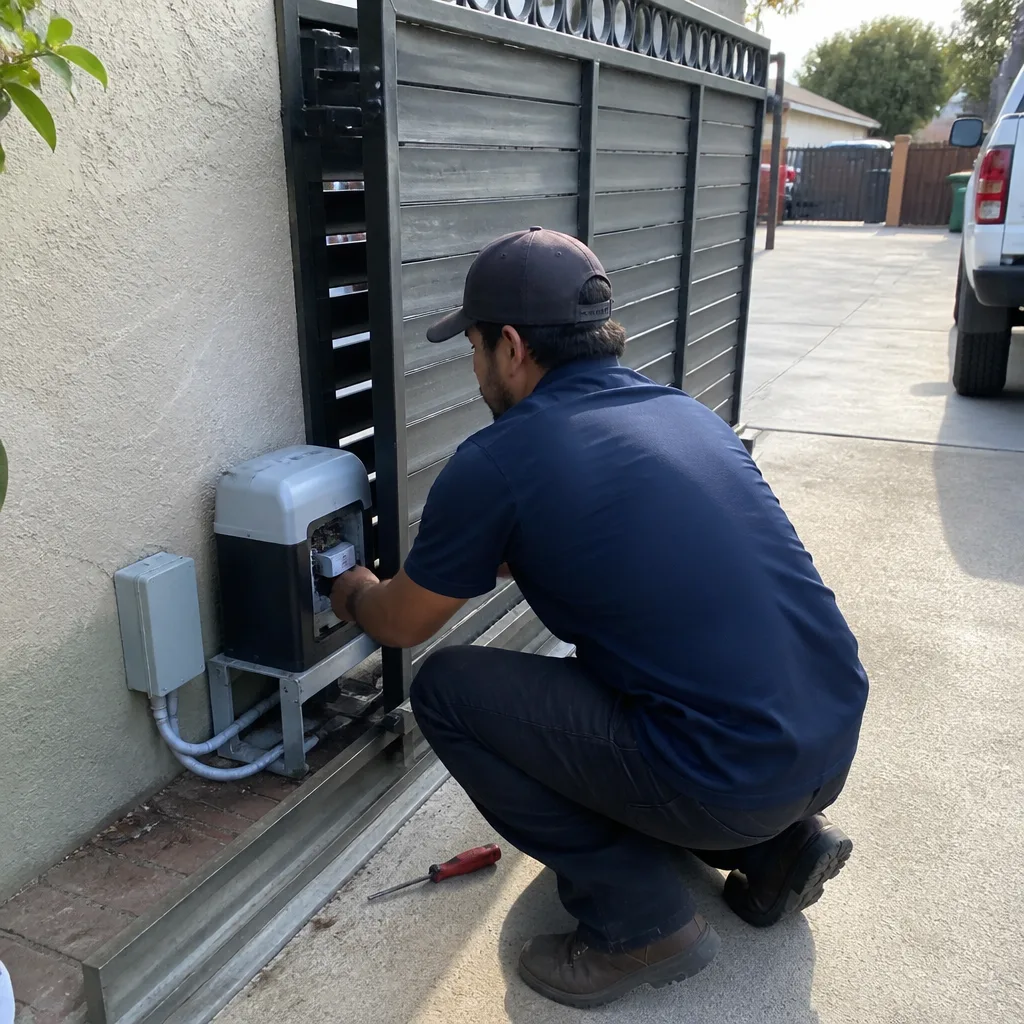 After
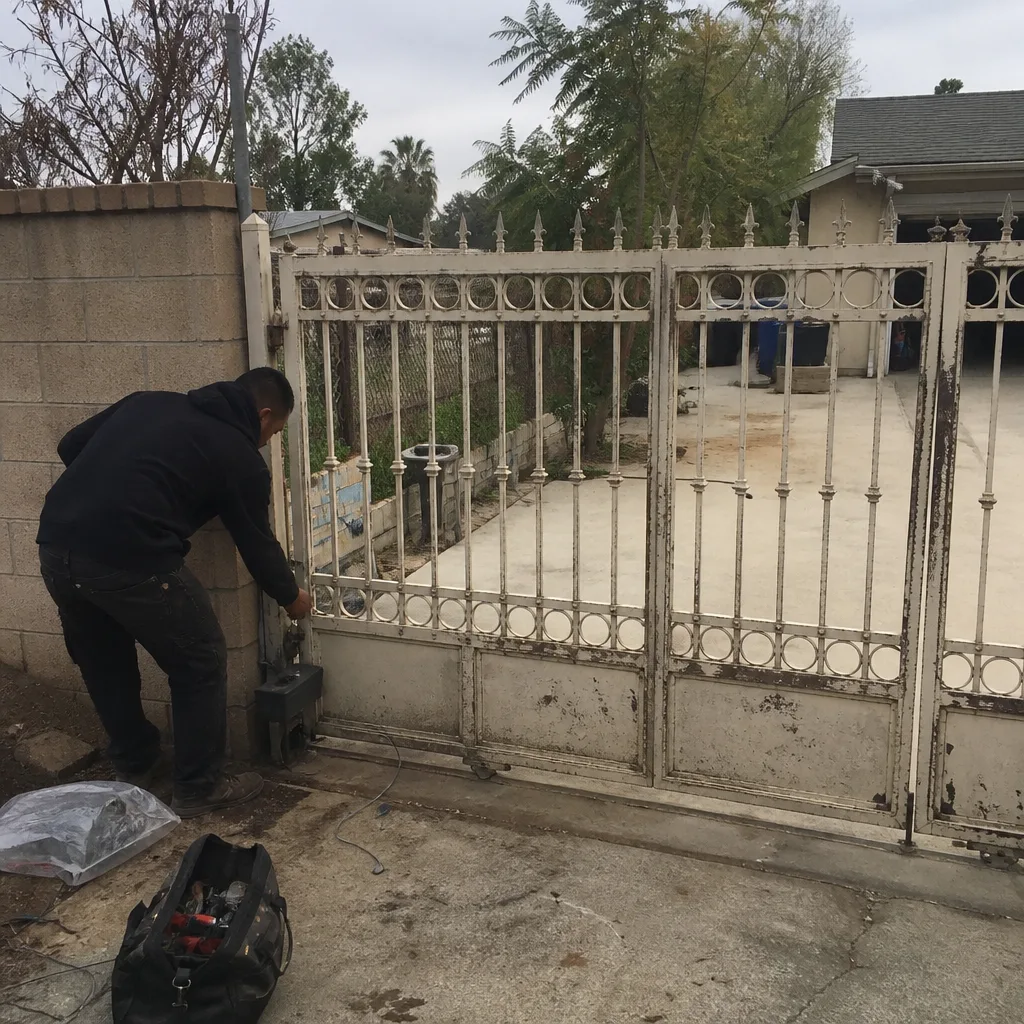 Before
 After
 Before
 After